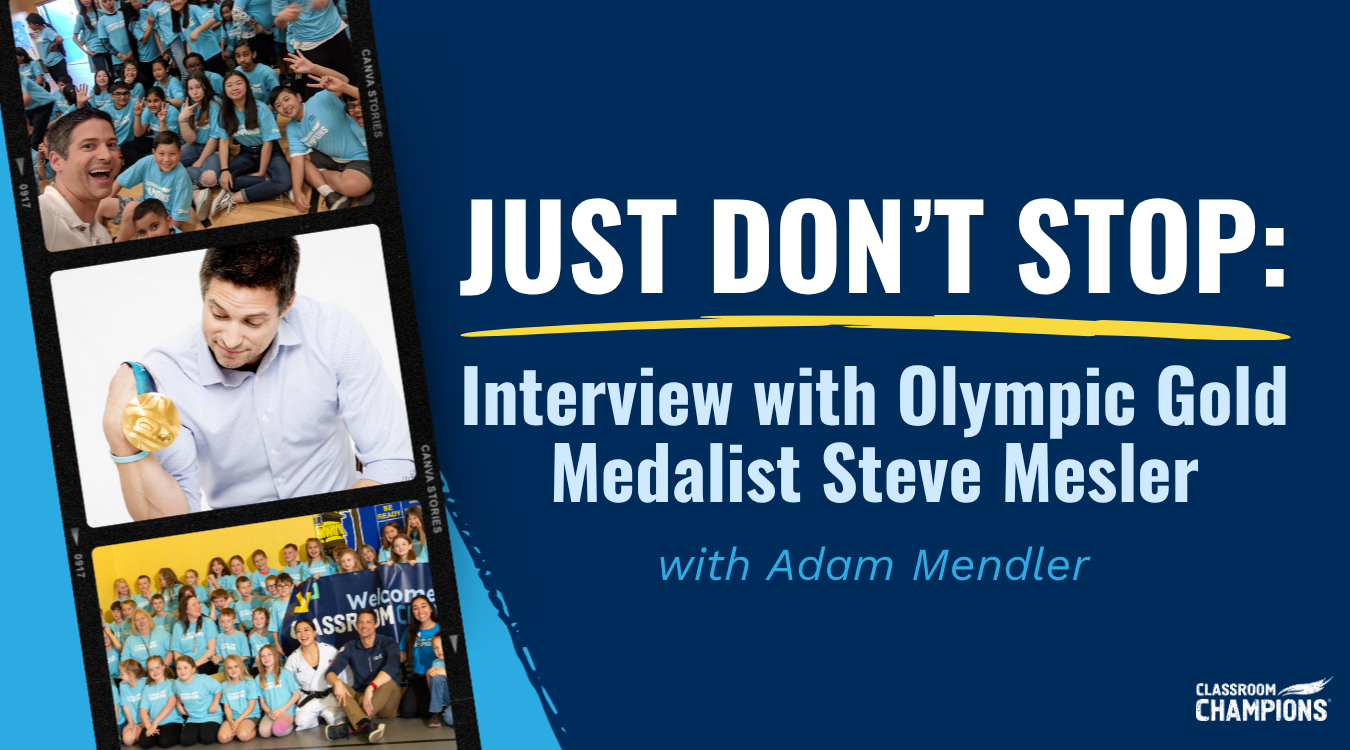
At Classroom Champions, we believe the lessons that shape great athletes are the same lessons that help young people thrive in school, careers, and life. Few people embody that belief more fully than Steve Mesler.Steve has spent his career exploring what it takes to build high-performing teams, navigate adversity, and lead with purpose. In this conversation with Adam Mendler, Steve shares insights on leadership, resilience, mentorship, and the mindset shifts that have guided him from elite sport to social impact.Whether you're an educator, business leader, parent, or lifelong learner, you'll find valuable takeaways on the power of relationships, the importance of character, and why investing in the next generation matters more than ever.

Adam: Thanks again for taking the time to share your advice. First things first, though, I am sure readers would love to learn more about you. How did you get here? What experiences, failures, setbacks, or challenges have been most instrumental to your growth?Steve: I was a national champion track athlete turned failure at one of the best NCAA programs in that country that threw a Hail Mary to save the Olympic Dream I’d been harboring since the age of 11 and became a 3-time Olympian bobsledder that led my team to innovate and break the mold to become the first American 4-man bobsled team to win Olympic gold in 62 years.From there, I decided to leave my comfort zone of sport and became a management consultant in the leadership development field working with numerous billion dollar+ market cap companies. At the same time, I was beginning to bake the non-profit, Classroom Champions, that my PhD educator sister and I incubated while I was in my last bobsled season, that’s now grown into an education powerhouse. Growing a business from idea to volunteer stage to full-on 30+ person enterprise is a never-ending cycle of joy, misery, excitement, and defeat that has raised more than $50M in resources and reached millions of kids to date.I simultaneously spent the past eight years as a member of the board of directors of the U.S. Olympic & Paralympic Committee where I was the first athlete to chair a committee in over a decade while faced with uncovering the Larry Nassar sexual abuse terribleness, spent days on end meeting with Senators and Members of Congress, dealt with Russian state-sponsored doping, IOC corruption, the first-ever postponement of the Olympics due to COVID, and an athlete uprising that played a large role in a hard, personal battle with depression that almost saw me meet the same fate as two of the six Olympic teammates I had to bury due to mental health issues. RIP Steve Holcomb and Pavle Jovonovic.Adam: What would surprise people about the Olympic experience? What was most surprising to you?Steve: That the experience of the journey is the thing that I would value ten-fold over the actual time at the Olympic Games. I always dreamed of “being an Olympian” or “going to the Olympics.” I hadn’t dreamt of the work, the long days, the monotony that it takes to be the best. That wasn’t what I thought I would both enjoy the most at the time and look back on with the most gratefulness.I’m now training to run the NY Marathon this fall at the invitation of the NY Road Runners to support Classroom Champions and I’m absolutely finding the daily, weekly, monthly grind of the miles the most fulfilling. Which is saying a lot for a guy who was once the best in the world at running for five seconds and sitting for a minute! I had not run more than five miles before April of this year and hadn’t run more than 6 miles before June – and now I’m finding those to be my short runs. It’s incredible and I’m loving the growth that it’s giving me both athletically and cognitively.

Adam: What are the best lessons you learned from the achievement of becoming an Olympic gold medalist?Steve: When the screws tighten is when culture matters most. Our 2006 team had medaled in the last three World Cup races going into the Olympic Games in Turino, Italy but we had a team that was not cohesive and a leader we didn’t get along with. We finished 7th at those Olympics, our worst finish in the four-year Olympic cycle across more than 40 races. We couldn’t, we didn’t know how, to lean on each other under pressure. Conversely, we made sure our 2010 team, of which I was the only holdover from “USA 1” (the top-ranked American sled), were tight as people on and off the track. When we passed each other during warm-ups, we could de-escalate the stress together. That was a valuable lesson for me. On a day-to-day (our World Cups at that point in our careers) basis it’s generally ok if folks don’t get along; but when the screws tighten and the pressure amps up, the ability to trust each other, alleviate stress for yourself and your team, is one of the most important features of a high-performing team.Adam: In your experience, what are the defining qualities of an effective leader? How can leaders and aspiring leaders take their leadership skills to the next level?Steve: Transparency, trustworthiness, and consistency. If you can put yourself in the upper 10% of each of those categories you will be able to inspire people to positive action; know that you will give yourself, your team, and your company the best opportunity to stay out of trouble; and be able to keep your stress levels at a manageable level.It helps to know your industry, work hard, and do all the things that elite performers need to do – but the people that I respect the most share the three qualities above. People like John Berardi, the founder of Precision Nutrition who helped me be honest about my mental health struggles and realize that if I can be transparent about that it will drive so much more, to Dexter Paine, founder of Paine Schwartz Partners and the most trustworthy person I’ve ever had the opportunity to work with as we spent a few years on the board of directors of the USOPC together.The rooms I’ve been fortunate enough to sit and the people I’ve been able to form mentoring relationships with in various ways have given me insight into how the best of the best operate – from Xbox’s Robbie Bach to Dan Doctoroff, most importantly the founder of Target ALS – to plenty of people I sat in those rooms with who also showed me if you don’t operate with transparency, trustworthiness, and consistency you are doomed to fail.I strive to be in that top 10% as often as I can and I also recognize that I fail at that at times… which only gives me more opportunities to improve.Adam: What are the defining characteristics of a great teammate?Steve: That’s a great question! The ability to foster trust in those around them through honesty is the root of most great teammate characteristics to me. Trust will allow your teammates to feel safe enough around you to be honest with you because you are honest with them. Honesty shows up in the ability to give critical feedback – an area that is probably the absolute worst parallel from sport to business of all the “team” analogies. I was shocked how poor critical feedback mechanisms were in the corporate world when I left sport, but that’s a rabbit hole for another day. If you know a good teammate will tell you what they really think, if they’ll be honest with you, in the long term that will play out best.Honesty and trust also means that I will trust you will be there when I need you, or you will be honest with me that you are unable to be. But that honesty will foster a “no surprises” mentality around the team that human beings thrive on.I knew Curt Tomasevicz would tell me what he thought because that was the only way we could possibly beat the German machine of Andre Lange in 2010 – the driver for the German team who ended his career after those 2010 Olympics with 4 gold medals and 1 silver. That 1 silver was to us.

Adam: What are the best lessons you have learned from your experience leading a nonprofit organization?Steve: First, there are two bottom lines to manage at a non-profit. A for-profit has one – profit margin. A non-profit has that to worry about since you still have to pay people, ensure an operating reserve, etc, but it also has the added complexity of an impact-margin. Non-profits are not here to simply exist to make money and do their work but rather ensure their work is making the impact the mission was created for. This can be lost quite often as people look to keep their jobs, keep the lights on, or scale to reach more stakeholders. The fact is that without profit, impact can’t be had; but without impact, “profit” for the organization shouldn’t be made.Next, a non-profit is a values-based, principles-driven business and the important decisions should always be run through that lens. I’ve sat in some high-stakes rooms where decisions impacted a lot of people and I’ve seen very smart people get things right and get things wrong. Almost always the decisions that were wrong can be traced back to not doing the values-based thing in the moment. Having sat on the Classroom Champions board for over 12 years and the USOPC’s for 8 years, I’ve been able to see the short, medium, and long-term consequences of those decisions play out.Finally, people’s motivation is different between non- and for-profit companies. Many companies on both sides of the profit line do organizational/pulse check surveys on a regular basis, even if that’s annually. From my experience in both consulting and around the boardroom tables with other leaders, for-profit leaders tend to only put so much weight on them; while I believe in a non-profit they are absolutely crucial tools. Why? Well, in for-profit the carrots are bigger so motivation comes from multiple places – yes, culture, but also stock options, material bonus incentives, significant raises from promotions, and so on. In non-profit you don’t have so many levers and so culture turns out to be much more heavily weighted in terms of motivation and retention.Adam: What is your best advice on building, leading, and managing teams?Steve: As you build your teams, pick people for culture and fit first, shiny skills and personalities will quickly be overshadowed if they can’t work with the rest of your organization. In leadership, my philosophy leans heavily on Dan Pink’s principles/Dan Ariely’s research that focus on “Mastery, Autonomy, and Purpose.” People love to get better at things, so give them opportunities to master domains; people prefer to work in whatever style best suits them, so give them as much autonomy to deliver as you can; and ultimately people are motivated in their lives through a sense of purpose – both how they fit in and what their purpose is with their work in the world but also how their work is purposeful to their teammates and or their company.Adam: What is the single best piece of advice you have ever received?Steve: “Just don’t stop.” This one comes from my quest to live a longer, healthier, happier life. I’ve begun asking people that I look up to who are in their 60’s and beyond that are fit, happy, still very engaged at work and with their friends and family a few simple questions – how do you do it? – what should I be thinking and doing right now in my mid-40’s to be like you in my 60’s and 70’s? And the best and most useable advice I’ve gotten has been to do all the things – lift weights, cardio, party with friends, love your family, work hard – and just don’t stop because if you do, it’s ten times harder to start back up.I love that and it keeps me motivated on days I just don’t want to.